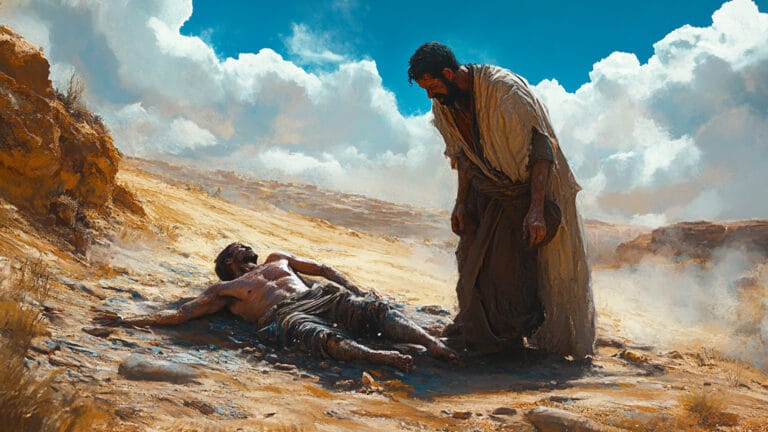
Image of God and Loving Your Neighbor
We as the Image of God
Genesis 1:26–27 – 26 Then God said, “Let us make humankind in our image, according to our likeness; and let them have dominion over the fish of the sea, and over the birds of the air, and over the cattle, and over all the wild animals of the earth, and over every creeping thing that creeps upon the earth.” 27 So God created humankind in his image, in the image of God he created them; male and female he created them. (NRSV)
We are created “in the image of God,” reflecting divine qualities like creativity, reason, and moral capacity. This “image” isn’t about physical resemblance but about our inherent value and the responsibility to care for creation. We are given dominion over the earth, not for exploitation, but for wise stewardship and compassionate care.
Diadochus of Photice (c. 400–474) states that “All men are made in God’s image; but to be in his likeness is granted only to those who through great love have brought their own freedom into subjection to God. For only when we do not belong to ourselves do we become like him who through love has reconciled us to himself. No one achieves this unless he persuades his soul not to be distracted by the false glitter of this life.”[1]
Avoiding Idolatry
Exodus 20:4 – 4 You shall not make for yourself an idol, whether in the form of anything that is in heaven above, or that is on the earth beneath, or that is in the water under the earth. (NRSV)
Why did God’s law prevent the creation of carved images in ancient Israel?
G. W. Ashby suggested that “A sacrifice placed before the image of a god was thought to be highly effective in gaining some benefit from the god. The sacrifice was expected to influence the actions of the deity. The ban on images in the second commandment is a ban on any attempt to control or limit Yahweh by making an image of him and thereby influencing him. Israel must understand the nature of her God and must not attempt to manipulate him.”[2]
He later adds, “In any case, God already has an image—humankind (Gen. 1:27). To worship an image and to offer sacrifice before it is to place a totally unnecessary intermediary between the divine and the human and to undervalue the worth of men and women created by God.”[3]
Psalm 135 provides valuable insight into the issue of idols.
Psalms 135:15-18
15 The idols of the nations are silver and gold, the work of human hands.
16 They have mouths, but they do not speak; they have eyes, but they do not see;
17 they have ears, but they do not hear, and there is no breath in their mouths.
18 Those who make them and all who trust them shall become like them. (NRSV)
Idols are lifeless, incapable of action or response. They offer no true help or guidance. By investing our faith and resources in idols, we become like them—an existence devoid of meaning and impact. He designed and created us to be His image and representation. By listening to those who suffer, we reflect a God who is a loving and compassionate father. God’s relational and loving nature cannot be reflected by a deaf idol.
We are His Image Bearers
Psalm 135 serves as a reminder of the futility of idolatry and the profound responsibility we bear as image-bearers of God. The psalmist created a vivid picture of idols as possessing the appearance of sentience—mouths that cannot speak, eyes that cannot see, ears that cannot hear—so they remain utterly unresponsive to the needs and cries of those who turn to them for comfort or wisdom.
This imagery isn’t limited to physically carved objects. When we invest our faith, time, resources, or our very selves into idols, whether they be material possessions, fleeting pleasures, or even well-intentioned but meaningless pursuits, we risk mirroring their lifelessness. We become, in essence, walking contradictions. Although we perceive the suffering, injustice, and issues of our world, we may become paralyzed by inaction, failing to make an impact because we prioritize things of no value. When we center our lives around things that cannot truly nourish or sustain us, we become increasingly detached from the life-giving source of true meaning and purpose. Our existence, like that of an idol, becomes a hollow shell, devoid of the vibrant, dynamic energy that comes from aligning our lives with God.
In contrast to the lifelessness of idols, God desires us to be living representations of His image. He has not created us to be passive entities, but active participants in the unfolding story of redemption. We are called to be conduits of His love, compassion, and justice in the world, to use our unique gifts and talents to bring light into the darkness, to speak truth to power, and to share the message of hope in a world where all is not right.
This is not a call to self-glorification, but a recognition of the profound dignity and purpose inherent in our creation. We are not merely human beings; we are beings created in the image of God, blessed with the capacity to reflect His love and to participate in His redemptive work in the world. When we embrace this calling, choosing to align our lives with His divine purpose, we step out of the shadows of lifelessness and into the radiance of true meaning and fulfillment.
Loving God
Mark 12:30-31 – 30 you shall love the Lord your God with all your heart, and with all your soul, and with all your mind, and with all your strength.’ 31 The second is this, ‘You shall love your neighbor as yourself.’ There is no other commandment greater than these.” (NRSV)
Love for God and love for neighbor are interconnected. Our love for others reveals our devotion to God, a truth mirrored in Jesus’ life and teachings. Serving those in need, showing compassion to the marginalized, etc.—these are acts of worship, tangible expressions of our love for God.
1 John 4:20 – 20 Those who say, “I love God,” and hate their brothers or sisters, are liars; for those who do not love a brother or sister whom they have seen, cannot love God whom they have not seen. (NRSV)
D. Moody Smith highlights that “once again John invokes the theme of seeing—or not seeing—God. The reality of the unseen God who is love is apprehended as we love one another (cf. 4:12), and the failure of love among those who see each other gives the lie to any claim of loving—or knowing—this unseen God.”[4] In essence, God is love and made visible in love. God is found and known through the experience of love. 1 John 4:8 points out the contradiction for us to claim love for God while not having love in our hearts.
Stephen S. Smalley summarizes “the vital, practical test of our love for God is to be found in our love for others”.[5]
Loving Others
We are not merely passive recipients of God’s grace, but active participants in God’s redemptive work in the world. We are called to be God’s representatives, to reflect His character, and to embody His love and justice in our interactions with others. Just as people in ancient times would seek to honor the gods by serving the idols that represented them, we are called to honor God by serving those who bear His image—our fellow human beings.
Jesus – The Purest Image
Jesus himself is the ultimate embodiment of this concept. He, the Son of God, took on human flesh, becoming the perfect image/likeness “ṣelem” or “צַלְמֵ֖” of the Father. Through His life, death, and resurrection, Jesus showed the true nature of God’s love and compassion. He showed us that true worship is not merely about reciting prayers or following religious rules; it is about living out our faith in tangible ways, by serving the needs of others.
Matthew 25:34-40 – 34 Then the king will say to those at his right hand, ‘Come, you that are blessed by my Father, inherit the kingdom prepared for you from the foundation of the world; 35 for I was hungry and you gave me food, I was thirsty and you gave me something to drink, I was a stranger and you welcomed me, 36 I was naked and you gave me clothing, I was sick and you took care of me, I was in prison and you visited me.’ 37 Then the righteous will answer him, ‘Lord, when was it that we saw you hungry and gave you food, or thirsty and gave you something to drink? 38 And when was it that we saw you a stranger and welcomed you, or naked and gave you clothing? 39 And when was it that we saw you sick or in prison and visited you?’ 40 And the king will answer them, ‘Truly I tell you, just as you did it to one of the least of these who are members of my family, you did it to me.’ (NRSV)
This verse highlights the reality that serving others reflects our service to Christ himself. When we feed the hungry, care for the sick, and visit the imprisoned, we are not merely helping people; we are encountering Christ in their midst. Our actions towards others are a reflection of our relationship with God.
Loving Others as Worship
This view calls us to see part of God in every human being, especially in the marginalized and vulnerable, and to respond with compassion, generosity, and justice. By serving others, we are not merely fulfilling a religious duty; we are taking part in the very essence of worship, reflecting the glory of God and embodying His love in the world. He wants us to be His image bearers, a living embodiment of God’s love and justice. We are to be tangible manifestations of God’s presence and care in the world. The concept isn’t meant to inflate our egos, but to instill a deep sense of humility and love for God, recognizing the profound dignity and love that God has bestowed upon us.
Reflecting the Trinity
Humans were created to live in connection with creation and each other, reflecting the communal nature of the triune God. This divine image in humanity implies that we are called to stewardship over creation, exercising dominion with love and care, as God’s representatives. The creation stories in Genesis emphasize that humans were placed on Earth with responsibilities to “till and keep” it, suggesting that our role is to nurture and develop creation in alignment with God’s will. Furthermore, the incarnation of Jesus Christ is presented as a profound expression of God’s love, with God sharing in human suffering and providing an example of being present in places of evil and suffering. This divine love finds its ultimate expression in Jesus’ sacrificial death on the cross, revealing the immeasurable depth of God’s love for humanity.[6]
William Sailer et al. in Religious and Theological Abstracts state that “being made after the image of the triune God—of the God in whose very bosom love binds the three divine persons—means that we are made for love, and this truth is so fundamental that our own identity depends on whom and what we love, and how we love them. Being made after the image of God implies that we have been created for love and for loving in such a way and to such a degree that, bearing and showing the image of God, we may also lead lives of love”.[7] The biblical and theological concept of humans being created in God’s image is the foundation for seeing a part of God in every person, thus recognizing their unique worth. This understanding emphasizes the incomparable dignity inherent in every individual.[8]
[1] Andrew Louth and Marco Conti, eds., Genesis 1–11, Ancient Christian Commentary on Scripture (Downers Grove, IL: InterVarsity Press, 2001), 30.
[2] G. W. Ashby, Go out and Meet God: A Commentary on the Book of Exodus, International Theological Commentary (Grand Rapids, MI; Edinburgh: Wm. B. Eerdmans; Handsel Press, 1998), 88.
[3] G. W. Ashby, Go out and Meet God: A Commentary on the Book of Exodus, International Theological Commentary (Grand Rapids, MI; Edinburgh: Wm. B. Eerdmans; Handsel Press, 1998), 89.
[4] D. Moody Smith, First, Second, and Third John, Interpretation, a Bible Commentary for Teaching and Preaching (Louisville, KY: John Knox Press, 1991), 115.
[5] Stephen S. Smalley, 1, 2, 3 John, vol. 51, Word Biblical Commentary (Dallas: Word, Incorporated, 1984), 262–263.
[6] Justo L. González, Knowing Our Faith: A Guide for Believers, Seekers, and Christian Communities (Grand Rapids, MI: William B. Eerdmans Publishing Company, 2019), 43.
[7] William Sailer et al., Religious and Theological Abstracts (Myerstown, PA: Religious and Theological Abstracts, 2012).
[8] William Sailer et al., Religious and Theological Abstracts (Myerstown, PA: Religious and Theological Abstracts, 2012).